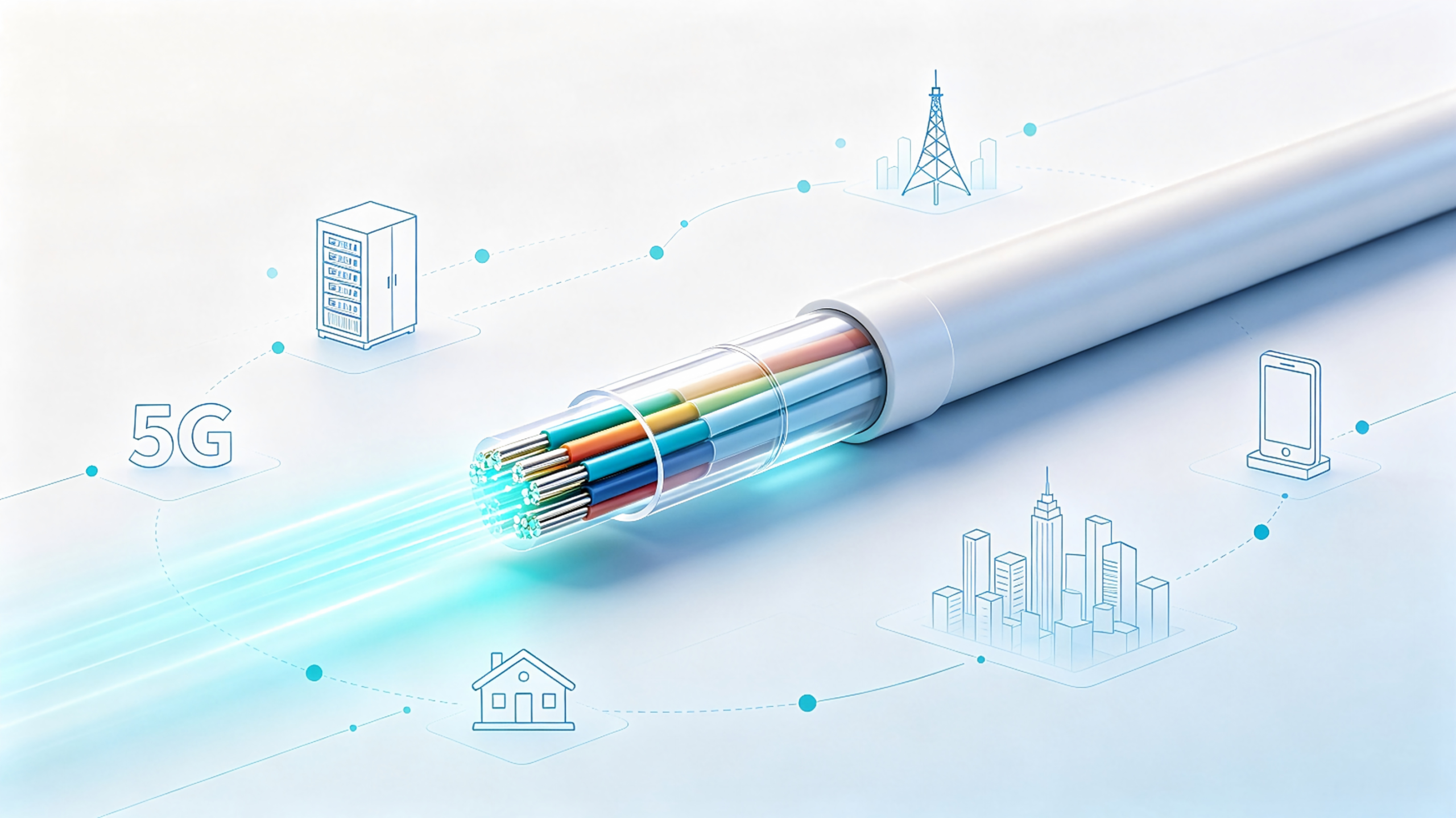
Air-blown cable technology is reshaping how fiber networks are designed, built, and expanded. Instead of pulling cables through conduits under mechanical tension, this approach uses compressed air to propel lightweight fiber units through pre-installed microducts. The outcome is an installation method defined by safety, efficiency, and enduring scalability.
The applications of air-blown cable extend across the entire spectrum of modern telecommunications infrastructure.
In Fiber-to-the-Home deployments, the technology enables cost-efficient network rollouts that tie infrastructure spending directly to subscriber demand. Operators install microduct pathways during initial construction, then introduce fiber only when neighborhoods or buildings require service activation. This just-in-time model keeps upfront capital expenditure low while preserving the capacity to scale rapidly as uptake grows.
Data centers represent another vital application area. Air-blown cable supports interconnect scenarios both within and between facilities, where dense fiber routes and frequent reconfiguration make conventional cabling impractical. The ability to add or replace fiber without disrupting ongoing operations delivers a degree of flexibility that fixed cabling simply cannot offer.
In campus and enterprise environments, air-blown cable infrastructure serves backbone and horizontal distribution requirements. Universities, corporate campuses, and industrial sites gain the ability to reconfigure network topology without physical construction. When departments relocate or bandwidth needs shift, fiber can be routed into alternative pathways or replaced outright without disturbing the underlying duct infrastructure.
Government and military installations have embraced air-blown cable for its capacity to enable network changes in restricted or secure zones without requiring construction crews to enter those areas. The technology supports rapid reconfiguration of network segmentation and classification separation—mission-critical requirements in sensitive environments where downtime carries serious consequences.
Long-haul and backbone networks likewise leverage air-blown installation for its extended reach. Reduced friction and distributed force application allow cables to travel far greater distances in a single run than traditional pulling methods, cutting the number of splice points and compressing deployment schedules.
Across every one of these applications, the core value proposition holds steady. Air-blown cable infrastructure separates the physical pathway from the fiber itself. Ducts are installed once, with ample capacity to accommodate decades of network evolution. Fiber is then introduced, removed, or upgraded as technology and demand dictate. This division of passive infrastructure from active components turns fiber from a fixed asset into a fluid resource—one that can be reconfigured in hours rather than weeks, and at a fraction of the cost of conventional methods.
As networks face unrelenting pressure to adapt, air-blown cable offers a practical route to infrastructure that is as dynamic as the services it supports.