10. DROP CABLE
10. DROP CABLE

DROP CABLE

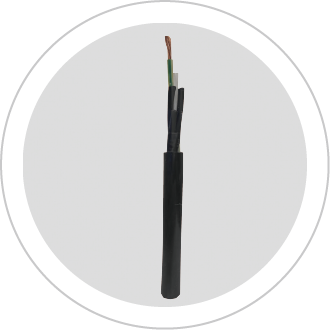
Communication optical cables are communication lines that take several optical fibers as the main body, and are protected by multiple layers of coating to achieve the transmission of optical signals.

Products Categories
Get A Free Quote
Contact Form

Advantages

  • High bandwidth: Fibers can provide extremely high bandwidth, meeting the requirements for high-speed data transmission. With technological advancements, the transmission rate of a single fiber has reached several tens of Gbps or even higher, capable of easily carrying a large amount of data, voice, and video signals, and meeting the requirements of future communication networks for large-capacity transmission.
  • Low attenuation: During the transmission of optical signals, the attenuation of fibers is very low. Especially for single-mode fibers, at specific wavelength windows (such as 1310nm and 1550nm), the attenuation coefficient can be as low as below 0.3dB/km, allowing optical signals to be transmitted over long distances without frequent signal amplification, reducing communication costs and system complexity.
  • Resistance to electromagnetic interference: Fibers are made of insulating materials such as glass or plastic and are not affected by external electromagnetic interference. In strong electromagnetic environments (such as substations, radar stations) or places with electromagnetic shielding requirements, they can ensure stable signal transmission without signal distortion or error codes.
  • Good confidentiality: Optical signals are transmitted within fibers, making them difficult to be eavesdropped. Compared to copper cables, fiber communication has higher confidentiality in terms of information security, suitable for transmitting sensitive information and important data, such as military communication, financial data transmission, and other fields.

Data Sheet

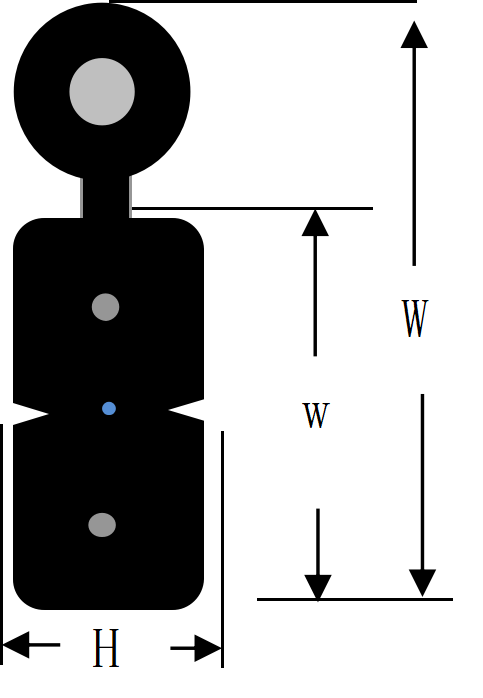
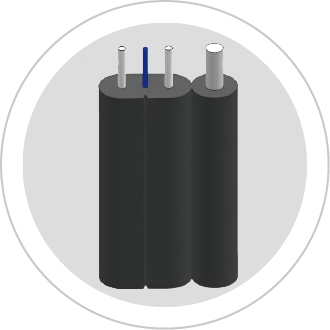
Cross Section:

Sketch map No Parts Spec Remark
1 Fiber Φ0.25mm±0.05 Blue
Number:1
2 Phosphating steel wire 1.2mm±0.1
3 Outer sheath (2.0×3.0×5.2)±0.2mm LSZH,Black colour
(H×w×W)
4 Phosphating steel wire 0.45±0.05mm
Number:2
5
6

Mechanical and Environmental Characteristics:

Item Test standard Spec Acceptance Criteria
Temperature Range Transportation& Storage IEC 60794-1 –20 to +70℃ Additional Loss≤0.3dB/km
Temperature Range Installation IEC 60794-1 –20 to +70℃ no damage
Temperature Cycling IEC 60794-1-F1 –20 to +70℃ No fiber break and shaeth damage
Cable Bend IEC 60794-1-E11 20 x D no damage
Dynamic Loadshort term IEC 60794-1 600N Increase Att.reversible fible strain<0.33%

Optical Characteristics:

Type of Fible G.657A1
Mode field diameter 8.5-9.3 um  at 1310nm
Attenuation in cable 0.40dB/km at 1310nm

0.30dB/km at 1550nm

Sheath Color Black
Sheath Marking Print:As Required
Drum Length As Required

Applications

  • Telecommunication networks: It is one of the most widely applied fields for communication optical cables. In long-distance communication trunk lines, it undertakes the communication tasks of connecting various cities, regions and even countries, achieving high-speed transmission of various services such as voice, data and images; In local access networks, the fiber-to-the-home (FTTH) technology directly lays optical fibers to users’ homes, providing users with ultra-high-speed broadband services.
  • Data centers: The data volume in data centers is huge and the transmission is frequent, requiring extremely high network bandwidth and transmission speed. Communication optical cables, with their high bandwidth and low latency characteristics, become the preferred transmission medium for internal servers, server-to-storage devices and data center-to-external network connections, ensuring the rapid and stable transmission of massive data.
  • Cable television: From the program production center of the TV station to the transmission station, and to various cable TV user terminals, the application of communication optical cables ensures the high-fidelity transmission of signals, achieving the widespread popularization of high-definition television, digital television and other services.
  • Smart transportation: In intelligent transportation systems, communication optical cables are used to connect traffic monitoring cameras, toll station equipment, vehicle automatic identification systems, etc., to realize real-time collection and transmission of traffic information, providing accurate data support for traffic management departments, thereby optimizing traffic flow, improving road traffic efficiency and ensuring traffic safety.

Related Products

Related News

Scroll to Top

Get A Free Quote Now !

Contact Form
If you have any questions, please do not hesitate to contact us.
about 3